Thursday, November 5, 2009
Illegal Mormon Immigrants


LDS Temples and Undocumented Immigrants
In regards to temples, the article says many times church leaders do not ask their citizenship status, thus implementing a "don't ask, don't tell" policy. The church believes that everyone who obeys the laws of the gospel should be able to reap the blessings. It also brought up the 12th article of faith and the fact that many people here illegally are not obeying the laws of the land. I think the church takes a spirit of the law perspective of this, because many of these undocumented immigrants believe God told them to come here in order to provide a better life for themselves.
Wednesday, November 4, 2009
Is BYU all about parity?
After 31 years of service, BYU is dissolving the Women's Research Institute. You don't know what the WRI is, shame on you, you don't get out enough. The WRI has been a beacon for women at BYU when mentoring and funding for research has been needed. It has helped the Church even dispel many myths of inequality in a highly patriarchal structured organization. Under representation in the sciences has been an ongoing struggle for women, which the WRI was helping to overcome.
So, how did this all come to pass? Why dissolve the program now, after 31 years? Why me, a man, is having this charge? And I know you are asking yourself, what can I do about it?
How?
The University claims in a press release that the WRI has not been meeting the mission statement of the organization. How much of a cop out is that? The program has been meeting the mission statement with great success and the legend of the institute in the past lives on. Completely dissolving the WRI would be like it never existing at all, nullifying all of the research that has been done to this date. What good did the work in the past do if it does not change the present or future? If for nothing else, keep the Institution for the sake of pride in the change it has brought forth till now.
Why?
In the official press release, BYU stated that the dissolving of the WRI was to “streamline and strengthen” the program. The press release also talks about creating a Women’s Resource Center, a Faculty Women’s Association and also $25,000 worth of grant money for research on women.
These programs already existed within the WRI. How is this streamlining, creating more organizations separate from each other? And the grant money, that was already apart of the WRI. Who is going to be in charge of distributing it? No doubt it will most likely be thrown to ORCA, especially considering ORCA has been stealing money from the WRI for years, funding studies other than woman.
This leads to the next question of why me, a man?
I will be the first to tell you how many people this impacts. It impacts all students. The dissolving of the WRI leads to less funds available to students who research women. That includes me, and about 20 other close friends and classmates.
Also, I had found out about this after a friend of a friend got wind of it in NYC. Yea, a person over 2000 miles away found out about it before we did. This is how sketchy BYU’s administrative policies are sometimes. They think that they can get away with dissolving such a crucial institution as the WRI without any hype. And, for those who think that I might be doing this for the sake of arguing, I say nay. If BYU wants to be viewed as an establish university, then it should do what Stanford, Yale, Harvard, U Penn, Michigan and Berkley do- have a WRI. I'm just looking out for the good ole' soon-to-be alma matter.
So, What can YOU do about it?
Talk to your professors, show them your discontent.
Also, join others on the issue:
http://www.facebook.com/group.php?gid=169442383235&ref=mf
Want to learn more about parity? Come to the meeting this Thursday, 7 pm 270 SWKT:
Wednesday, October 28, 2009
Driving While Speaking Spanish
Hate Crimes Legislation
Monday, October 26, 2009
Hate Groups and Religious Extremism
"The Most Hated Family in America" is a documentary concerning the Westboro Baptist Church. Made in 2007 by the BBC, reporter Louis Theroux follows the church membership through their daily activities, such as picketing soldier's funerals with signs saying "God Hates Fags."
"In their world, being hated was proof they were doing the right thing."
Does this sound familiar?
In my view, the Phelps family has dug themselves into a paradox. While they proclaim that America is doomed and its armed-forces promote sodomy, it is the very government they protest that protects their right to say so. They are currently not allowed to enter the United Kingdom.
Do you think the government should have laws prohibiting these kinds of demonstrations? The US has laws that prohibit hate speech in public institutions. In some way, this documentary makes me a little more patriotic, for it is the most extreme freedom of speech - a reminder that we, as citizens, have the right to openly speak. Some say it is not for us to judge them; do you think that is dancing around the issue?
I also found this clip interesting. It is from the 2006 documentary "Jesus Camp."
What do you think?
Hotel owner tells Hispanic workers to change names
TAOS, N.M. – Larry Whitten marched into this northern New Mexico town in late July on a mission: resurrect a failing hotel.
The tough-talking former Marine immediately laid down some new rules. Among them, he forbade the Hispanic workers at the run-down, Southwestern adobe-style hotel from speaking Spanish in his presence (he thought they'd be talking about him), and ordered some to Anglicize their names.
No more Martin (Mahr-TEEN). It was plain-old Martin. No more Marcos. Now it would be Mark.
Whitten's management style had worked for him as he's turned around other distressed hotels he bought in recent years across the country.
The 63-year-old Texan, however, wasn't prepared for what followed.
His rules and his firing of several Hispanic employees angered his employees and many in this liberal enclave of 5,000 residents at the base of the Sangre de Cristo mountains, where the most alternative of lifestyles can find a home and where Spanish language, culture and traditions have a long and revered history.
"I came into this landmine of Anglos versus Spanish versus Mexicans versus Indians versus everybody up here. I'm just doing what I've always done," he says.
Former workers, their relatives and some town residents picketed across the street from the hotel.
"I do feel he's a racist, but he's a racist out of ignorance. He doesn't know that what he's doing is wrong," says protester Juanito Burns Jr., who identified himself as prime minister of an activist group called Los Brown Berets de Nuevo Mexico.
The Virginia-born Whitten had spent 40 years in the hotel business, turning around more than 20 hotels in Texas, Oklahoma, Florida and South Carolina, before moving with his wife to Taos from Abilene, Texas. He had visited Taos before, and liked its beauty. When Whitten saw that the Paragon Inn was up for sale, he jumped at it.
The hotel sits along narrow, two-lane Paseo del Pueblo, where souped-up lowriders radiate a just-waxed gleam in the soft sunshine as they cruise past centuries-old adobe buildings. One recent afternoon, a woman slowly rode her fat-tire bicycle along a cracked sidewalk, oversized purple butterfly wings on her back and a breeze blowing her long, blonde dreadlocks.
The community includes Taos Pueblo, an American Indian dwelling inhabited for over 1,000 years, and an adobe Catholic church made famous in a Georgia O'Keeffe painting.
After he arrived, Whitten met with the employees. He says he immediately noticed that they were hostile to his management style and worried they might start talking about him in Spanish.
"Because of that, I asked the people in my presence to speak only English because I do not understand Spanish," Whitten says. "I've been working 24 years in Texas and we have a lot of Spanish people there. I've never had to ask anyone to speak only English in front of me because I've never had a reason to."
Some employees were fired, Whitten says, because they were hostile and insubordinate. He says they called him "a white (N-word)."
Fired hotel manager Kathy Archuleta says the workers initially tried to adjust to his style. "We had already gone through four or five owners before him, so we knew what to expect," Archuleta says. "I told (the workers) we needed to give him a chance."
Then Whitten told some employees he was changing their Spanish first names. Whitten says it's a routine practice at his hotels to change first names of employees who work the front desk phones or deal directly with guests if their names are difficult to understand or pronounce.
"It has nothing to do with racism. I'm not doing it for any reason other than for the satisfaction of my guests, because people calling from all over America don't know the Spanish accents or the Spanish culture or Spanish anything," Whitten says.
Martin Gutierrez, another fired employee, says he felt disrespected when he was told to use the unaccented Martin as his name. He says he told Whitten that Spanish was spoken in New Mexico before English. "He told me he didn't care what I thought because this was his business," Gutierrez says.
"I don't have to change my name and language or heritage," he says. "I'm professional the way I am."
After the firings, the New Mexico chapter of the League of United Latin American Citizens, a national civil rights group, sent Whitten a letter, raising concerns about treatment of Hispanic workers. Whitten says he sent them a letter and posted messages on the hotel marquee, alleging that the group referred to him with a racial slur. LULAC denied the charge.
The messages and comments he made in interviews with local media, including referring to townsfolk as "mountain people" and "potheads who escaped society," further enflamed tensions.
Taos Mayor Darren Cordova says Whitten wasn't doing anything illegal. But he says Whitten failed to better familiarize himself with the town and its culture before deciding to buy the hotel for $2 million. "Taos is so unique that you would not do anything in Taos that you would do elsewhere," he says.
Whitten grew subdued as a two-hour interview with The Associated Press progressed. He said he was sorry for the misunderstanding and insisted he has never been against any culture.
"What kind of fool or idiot or poor businessman would I be to orchestrate this whole crazy thing that's costed me a lot of time, money and aggravation?" Whitten said.
Whitten should have dealt with the situation differently, especially in a majority Hispanic town, said 71-year-old Taos artist Ken O'Neil, while sipping his afternoon coffee on the town's historic plaza.
"To make demands like he did just seems over the top," he says. "Nobody won here. It's not always about winning. Sometimes, it's about what you learn."
Whitten definitely seems like a racist, but of course he won't admit it. He is trying to justify his actions. He thinks that it is okay to change the names of his employees who work the front desk so that they are easier to pronounce. I have been to plenty of hotels where there are people from all over the world working. They keep their name and are very open to telling you how to pronounce it. They are proud f their heritage and their bosses let them be. They are not forced to become more Americanized. Whitten has no right to force his employees to become more Americanized and change who they really are. It is also interesting that the hotel that he is trying to revamp is in an area that has a unique heritage and culture that is important. It is wrong to force people into your own way of life just because they are different from you.
Sunday, October 25, 2009
CNN: Lou Dobbs or Latinos in America?
What do you think? Should Lou Dobbs be tolerated or should he be fired?
Thursday, October 22, 2009
Sex ed and a trip to Hooters
After a big victory in a youth football game recently, my parents and I took my 11-year-old son toHooters for lunch. Though this was his first trip to Hooters, he knew from his friends exactly what the restaurant chain is famous for.

Wednesday, October 21, 2009
What does it mean to be a Feminist?
Lately I have been looking through several different podcasts and I happened to stumble upon one called, Stuff Mom Never Told You, which I found very interesting. One episode that I found particularly intriguing was one titled "What does a feminist look like?" Among our generation, feminism seems to have such a negative connotation. I agree with a lot of the issues that feminist fight for, but I don't necessarily want to label myself as a feminist because it seems like it always carries such a negative tone. Some of the social and political baggage that accompanies the title of "feminist" does not fit with ideas that I hold from being a member of the Church of Jesus Christ of Latter-Day Saints, such as abortion rights.
However, after listening to this podcast it gave me a lot to think about. They define feminism as "the theory of the political, economic, and social equality of the sexes/organized on behalf of women's rights and interests." According to this definition I think that I would generally define myself as a feminist. Anyways, I guess my question here would be what exactly does it mean to be a feminist?
I thought that this was pretty interesting too. I found this article on http://people.howstuffworks.com/feminism.htm.
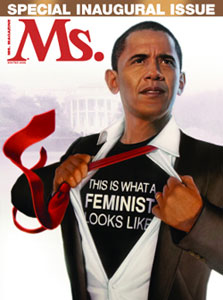
Ms. magazine hit stands for the first time in 1972 with the headline, "Wonder Woman For President," stretched above an image of the comic book heroine. Thirty-seven years later, a cover depicting Barack Obama in a Superman-like pose and wearing a T-shirt that proclaimed, "This is What a Feminist Looks Like," struck a chord among Ms. readers. Some applauded the clever twist, hailing Obama's progressive political platforms. Others derided the magazine for defining a feminist as a man.
That reaction among the magazine's feminist readers demonstrated the inherent challenge of defining what feminism is precisely. Depending on the context, you can spin the term as a philosophy, social movement, history, badge of honor or an insult. While feminists have made radical strides toward gender equality and flung open many new doors for women, the movement and philosophy behind it have become culturally and politically polarizing. For instance, when conservative Alaska governor Sarah Palin told Katie Couric that she considers herself a feminist, shock waves rippled throughout the feminist community. As an outright opponent of abortion and sex education in schools, how could Gov. Palin possibly fit the feminist mold, some asked. But politics aside, a working mother of five running for vice president hardly seems antifeminist.
At its core, feminism is the belief in equality. It seeks to eliminate the social, cultural and legal barriers between men and women. Its goal is to create a truly egalitarian society. Beyond that, the waters grow murkier. Feminist factions disagree sometimes on what constitutes equality -- whether it's sexual freedom, career advancement or something else. Some people who label themselves feminists perceive that battle for equality as over and done with; others still view society as rife with patriarchal restrictions. Recently, a debate has stirred over whether feminism has become outdated as term and should even be used at all.
So is feminism today a potent force for change? Or is it the "f-word," spit out like a bitter seed? By examining its unifying philosophies and causes, as well as the schisms within the movement, we can properly evaluate and answer those questions.
According to feminist theology, men have always enjoyed at least some form of gender-based privilege, whatever their class or race. Therefore, some people have questioned whether men can really be feminists. President Barack Obama has labeled himself as a feminist, and plenty of men ascribe to feminist principles of ending sexual discrimination and patriarchy. Most leading feminists welcome men's participation in the movement, but not all allow their male compatriots to call themselves feminists. Some groups -- including members of the National Organization for Men Against Sexism -- identify men as pro-feminist, instead.
So my second question would be, do you think that it is alright for a man to say that he is a feminist as well? It seems contradictory for a feminist to be offended that a man would want to stand up with them for equality. What about men that don't even know what feminism means and they have to look it up in a dictionary?...


