Lately I have been looking through several different podcasts and I happened to stumble upon one called, Stuff Mom Never Told You, which I found very interesting. One episode that I found particularly intriguing was one titled "What does a feminist look like?" Among our generation, feminism seems to have such a negative connotation. I agree with a lot of the issues that feminist fight for, but I don't necessarily want to label myself as a feminist because it seems like it always carries such a negative tone. Some of the social and political baggage that accompanies the title of "feminist" does not fit with ideas that I hold from being a member of the Church of Jesus Christ of Latter-Day Saints, such as abortion rights.
However, after listening to this podcast it gave me a lot to think about. They define feminism as "the theory of the political, economic, and social equality of the sexes/organized on behalf of women's rights and interests." According to this definition I think that I would generally define myself as a feminist. Anyways, I guess my question here would be what exactly does it mean to be a feminist?
I thought that this was pretty interesting too. I found this article on http://people.howstuffworks.com/feminism.htm.
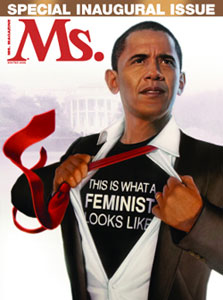
Ms. magazine hit stands for the first time in 1972 with the headline, "Wonder Woman For President," stretched above an image of the comic book heroine. Thirty-seven years later, a cover depicting Barack Obama in a Superman-like pose and wearing a T-shirt that proclaimed, "This is What a Feminist Looks Like," struck a chord among Ms. readers. Some applauded the clever twist, hailing Obama's progressive political platforms. Others derided the magazine for defining a feminist as a man.
That reaction among the magazine's feminist readers demonstrated the inherent challenge of defining what feminism is precisely. Depending on the context, you can spin the term as a philosophy, social movement, history, badge of honor or an insult. While feminists have made radical strides toward gender equality and flung open many new doors for women, the movement and philosophy behind it have become culturally and politically polarizing. For instance, when conservative Alaska governor Sarah Palin told Katie Couric that she considers herself a feminist, shock waves rippled throughout the feminist community. As an outright opponent of abortion and sex education in schools, how could Gov. Palin possibly fit the feminist mold, some asked. But politics aside, a working mother of five running for vice president hardly seems antifeminist.
At its core, feminism is the belief in equality. It seeks to eliminate the social, cultural and legal barriers between men and women. Its goal is to create a truly egalitarian society. Beyond that, the waters grow murkier. Feminist factions disagree sometimes on what constitutes equality -- whether it's sexual freedom, career advancement or something else. Some people who label themselves feminists perceive that battle for equality as over and done with; others still view society as rife with patriarchal restrictions. Recently, a debate has stirred over whether feminism has become outdated as term and should even be used at all.
So is feminism today a potent force for change? Or is it the "f-word," spit out like a bitter seed? By examining its unifying philosophies and causes, as well as the schisms within the movement, we can properly evaluate and answer those questions.
According to feminist theology, men have always enjoyed at least some form of gender-based privilege, whatever their class or race. Therefore, some people have questioned whether men can really be feminists. President Barack Obama has labeled himself as a feminist, and plenty of men ascribe to feminist principles of ending sexual discrimination and patriarchy. Most leading feminists welcome men's participation in the movement, but not all allow their male compatriots to call themselves feminists. Some groups -- including members of the National Organization for Men Against Sexism -- identify men as pro-feminist, instead.
So my second question would be, do you think that it is alright for a man to say that he is a feminist as well? It seems contradictory for a feminist to be offended that a man would want to stand up with them for equality. What about men that don't even know what feminism means and they have to look it up in a dictionary?...


I've called myself a Feminist for a few years now, ever since I had a fantastic instructor at another college. I've definitely had a lot of strange reactions to it here at BYU (usually my intelligence ends up being insulted). Today, a teacher of mine said, "I hate Feminism." I responded with, "Don't people who hate Feminism hate women?" Many Christian men think that bringing up divine roles excuses their androcentric beliefs. I disagree. I'm weary of people blaming their ignorance on God.
ReplyDeleteWhether people are going to label it feminist or pro-feminist, if we are going on the assumption/belief that feminism is defined as "equality for both genders"...then I would say yes, men can definitely fall into the feminist category.
ReplyDeleteI think the whole question exists because women are usually more powerful about voicing their beliefs in feminism then men are. Let the men speak out too! Otherwise, we are turning women into the dominating gender, which is what we were running from (and advocating feminism for) in the first place. Talk about a vicious cycle.
This is what a feminist looks like!
ReplyDeleteAs a male who identifies as a feminist, I agree with Samantha that to be successful the feminist movement will need to include both men and women. One of the ultimate goals of feminism is to deconstruct the dominant androcentric paradigm and not just "tack women's equality on the end" but to actually create a new social structure that is informed from both female and male experience. A (biased) male perspective is still too often assumed in media, research, and other social domains, and so the solution lies in women and men working together to create a non-oppressive, less-biased system.
ReplyDeleteWhen women say they want to be treated socially and culturally equally does that mean they no longer want men to open doors or to be served first? I still want that. Men and women have different social and cultural roles. Being a woman and having a different role than a man makes me a little more unique in this large world. Having different roles makes men and women interesting to each other. Our separate roles help us have humility. We need each other because we cannot do everything alone. There are so many responsibilities for a woman, I don’t know how some women try to do all that a woman does and all that a man does! Yes, I do believe women should have the same legal rights men do and should be treated with respect just as men are. Sometimes I feel that some feminists want superiority and not just equality.
ReplyDeleteIn regard to women seeking social and cultural equality I think the focus should first be on helping women realize their self-worth. We have more to us than our bodies. TV often only portrays how gorgeous women’s bodies are and how it brings sexual pleasure or helps them get what they want, but I do not want to be seen for that. No one should be stereotypical and judge someone before they meet them, but we all know everyone does it. That is why it is important to be a good example. If we want respect we must first respect ourselves, especially our bodies.
I do see myself as a feminist. I would have never put that label on myself before taking Introduction to Women's Studies (WS 222), but knowing the issues and problems that confront women all across the globe, I have realized that labels should not stand in the way of gaining rights for every woman, no matter what her background, race, economic status, religion, or beliefs may be. Everyone deserves to receive equal treatment. For me, feminism means supporting the ideas of equality between men and women and “redress[ing] injustices against women” (Richards, 1992). As members of the Church of Jesus Christ of Latter-day Saints, we should understand the doctrine of the worth of souls and divine worth and in turn, by certain definitions of feminism, all proudly call ourselves feminists.
ReplyDelete